


How to Read a Plywood Quotation: FOB, CIF, Thickness, Core and Glue Explained
Quick answer: A lower plywood unit price does not always mean a lower final cost. Before comparing quotations, buyers should confirm whether the price is FOB or CIF, whether it is quoted per sheet or per cubic metre, and whether the size, thickness, core, glue, grade, packing and quantity are identical.
What Does FOB Mean in Plywood Export?
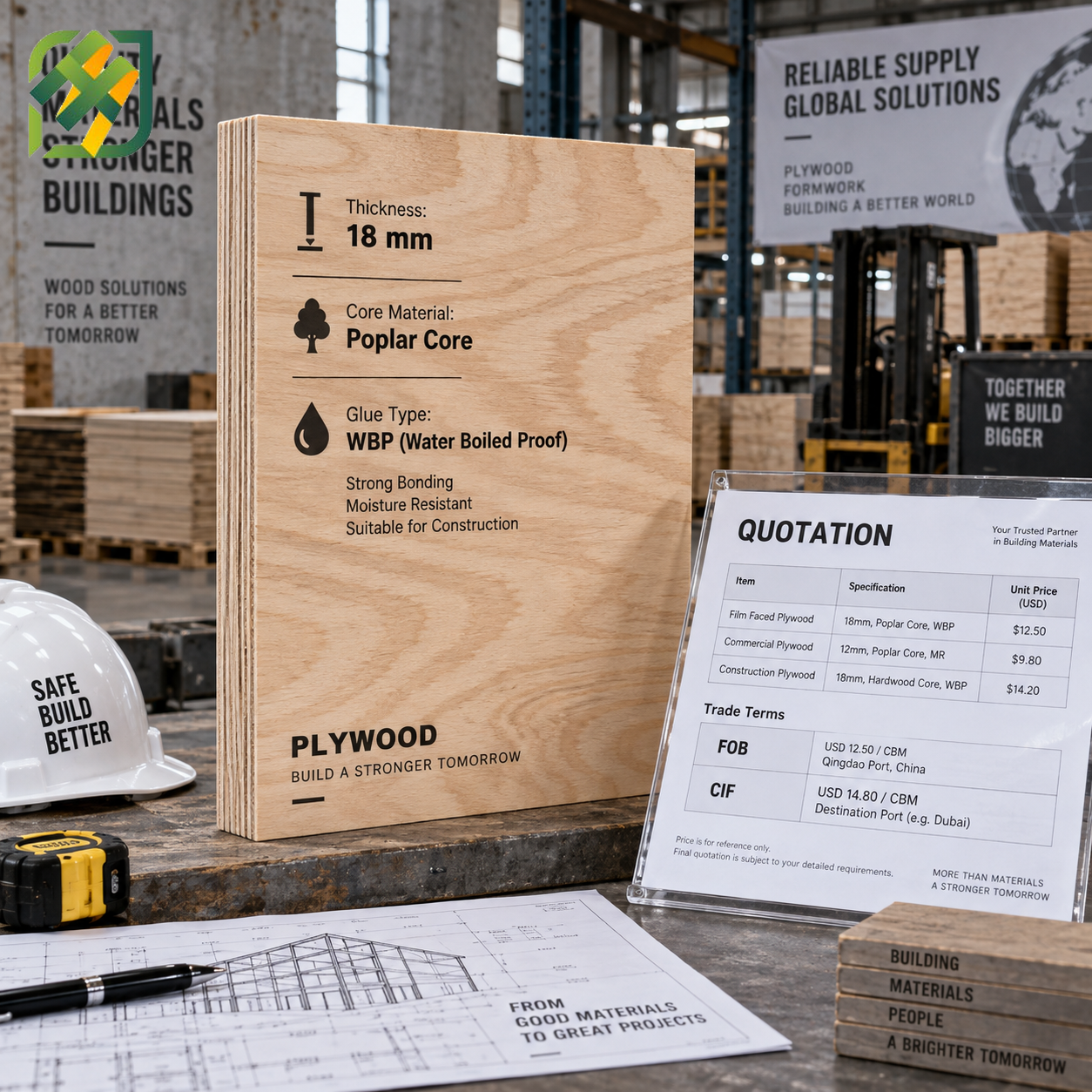
FOB means Free On Board. A quotation should name the port of shipment, for example, FOB Qingdao. Under the FOB rule, the seller completes the agreed export delivery and places the goods on board the vessel at the named port. The buyer normally arranges and pays for the main ocean freight from that port.
The named port matters because inland transport and export-port costs differ. A quotation that only says “FOB price” without naming the port is incomplete. Buyers should also confirm which local charges and documents are included.
FOB is widely used in plywood trading. For containerized cargo delivered to a terminal before vessel loading, the parties may also consider whether FCA, or Free Carrier, better matches the actual delivery arrangement. The agreed trade rule and named place should be written clearly in the contract.
What Does CIF Mean?
CIF means Cost, Insurance and Freight. A CIF quotation should name the destination port, such as CIF Jebel Ali. The seller arranges and pays for the ocean freight and the required cargo insurance to the named destination port.
CIF does not automatically mean that every cost at the destination is included. Import duty, tax, customs clearance, port handling, storage, demurrage and inland delivery are normally separate unless the quotation or contract specifically includes them.
Another common misunderstanding concerns risk. Under CIF, the seller pays freight and insurance to the destination port, but the transfer of risk is linked to delivery on board the vessel at the port of shipment under the agreed Incoterms rule. Buyers should review the insurance coverage and claim documents instead of assuming that CIF makes the seller responsible for every event until arrival.
How Does Plywood Thickness Affect Price?
For the same sheet size and plywood construction, a thicker panel generally requires more veneer, glue, pressing time and shipping weight. This normally increases the price per sheet and reduces the number of sheets that can be loaded within the container weight limit.
Buyers should distinguish between nominal thickness and the agreed thickness tolerance. Two quotations may both say “18mm”, but the actual thickness requirement, sanding allowance and permitted tolerance may differ. The quotation should state the size, thickness, tolerance and unit of sale clearly.
- Price per sheet: Easy to compare only when every specification is the same.
- Price per cubic metre: Useful for comparing different thicknesses, but quality and construction must still match.
- Container quantity: Depends on sheet size, thickness, density, pallet weight and destination transport limits.
How Does Core Material Affect Price?
The plywood core affects weight, strength, edge quality, screw holding, flatness and cost. Common options may include poplar, eucalyptus, hardwood, birch or combi constructions, depending on the product and application.
- Poplar core: Usually lighter and often selected for economical or weight-sensitive orders.
- Eucalyptus or hardwood core: Generally denser and may be selected when higher panel strength is required.
- Combi core: Combines different veneer species to balance cost, weight and performance.
- Birch construction: Often selected for higher-grade furniture, machining or industrial applications when the specification requires it.
Species names alone do not define plywood quality. Buyers should also confirm veneer thickness, number of plies, core gaps, overlapping veneers, repairs, moisture content and the required product grade.
How Does Glue Type Affect Price?
Glue should be selected according to the plywood application and expected exposure conditions. A quotation may refer to MR glue, melamine glue, WBP glue or another confirmed bonding system. The required test method and supporting documents should be agreed before production when bonding performance is important to the project.
- MR glue: Commonly considered for dry and protected interior applications.
- Melamine glue: May be selected when improved moisture performance is required for an appropriate plywood product.
- WBP bonding: Often requested for formwork and applications requiring stronger water-resistant bonding.
E0 and E1 are formaldehyde-emission requirements or market classifications, not glue names. Buyers should not treat “E0 glue” or “E1 glue” as a complete technical specification. The emission class, test method and supporting report should be stated separately from the glue type.
How Do Packing and Freight Affect the Final Cost?
Export pallet packing, protective panels, plastic wrapping, corner protection, straps and customized labels add material and handling costs. They also add weight and occupy some container space, but suitable packing helps reduce transport damage.
Ocean freight changes with the route, carrier, season, container availability and quotation validity period. A CIF offer should therefore state the destination port and validity date. Buyers should also ask whether the freight is based on a 20GP, 40GP or 40HQ container and whether the estimated loading quantity has been calculated from the actual plywood specification.
What Should a Complete Plywood Quotation Include?
- Exact product name and intended application
- Length, width, thickness and permitted tolerance
- Face, back, core construction and product grade
- Glue type and any separate emission requirement
- Surface, sanding, film, edge or processing requirements
- Unit price per sheet or per cubic metre
- FOB shipment port or CIF destination port
- Order quantity, sheets per pallet and estimated container loading
- Packing, labels, shipping marks and required documents
- Payment terms, production time and quotation validity
A useful quotation line should read like this: 1220*2440*18mm film faced plywood, confirmed core, black film, confirmed glue, sealed edges, export pallet packing, price per sheet, FOB named port, one container and stated quotation validity. This is more meaningful than a unit price without specifications.
Send Your Plywood Inquiry
Review Haoxin’s plywood product range, then tell us your required product, size, thickness, core, glue, grade, quantity, packing method, trade term and destination port. Haoxin will prepare a quotation according to the confirmed specification and shipment requirements.
Leave A Message
If you are interested in our products and want to know more details, please leave a message here, we will reply you as soon as we can.